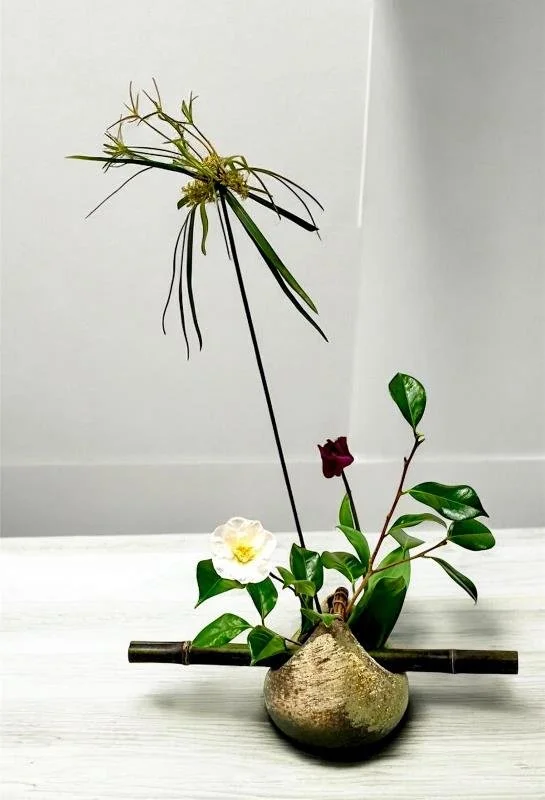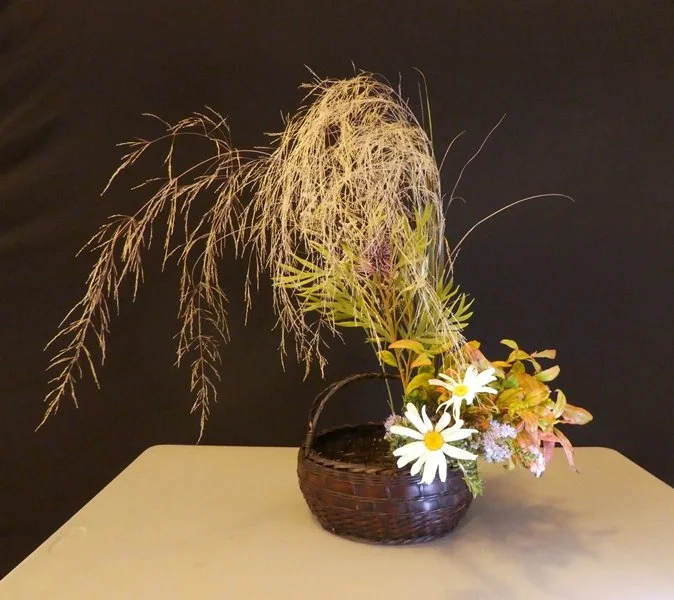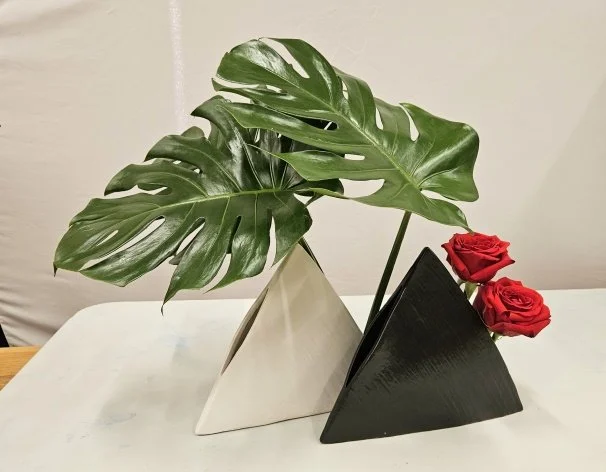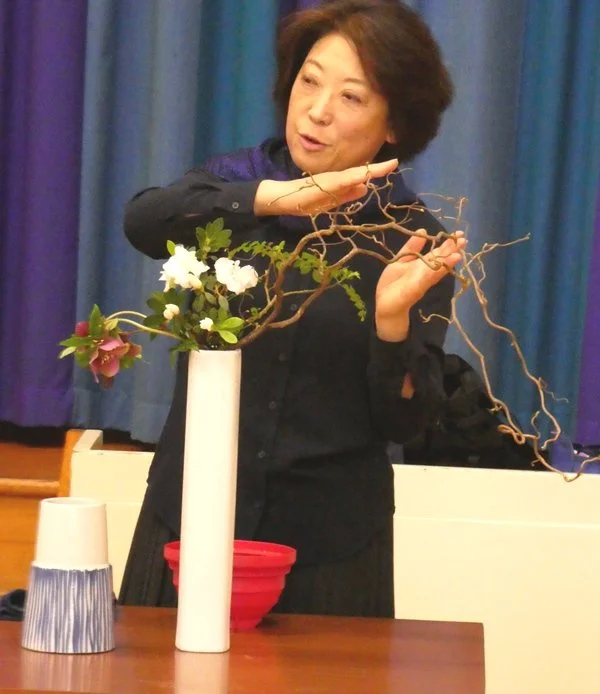
A Workshop led by Kathy Kerry: Theme 'Using Only One Kind of Material'
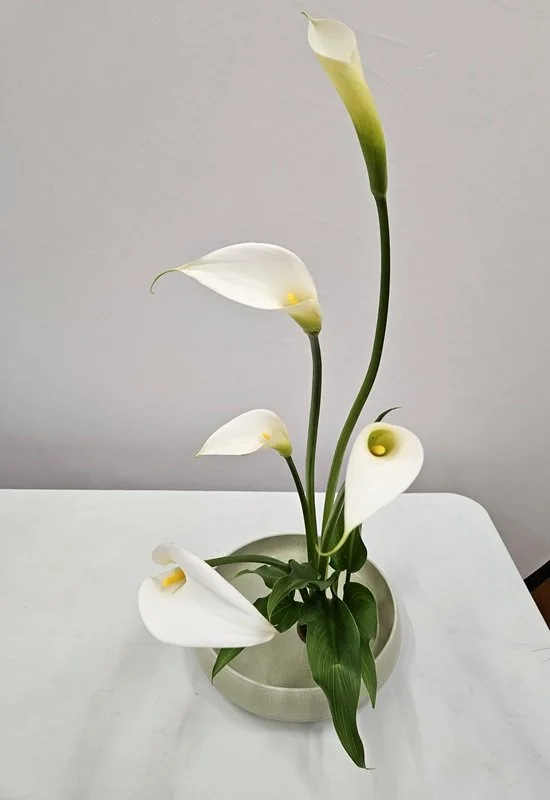
Arum lilies
Our monthly workshop will be held on Sunday June 14, 2pm to 4pm in Khandallah Presbyterian Church Hall, 33 Ganges Road.
Kathy has provided the following notes:
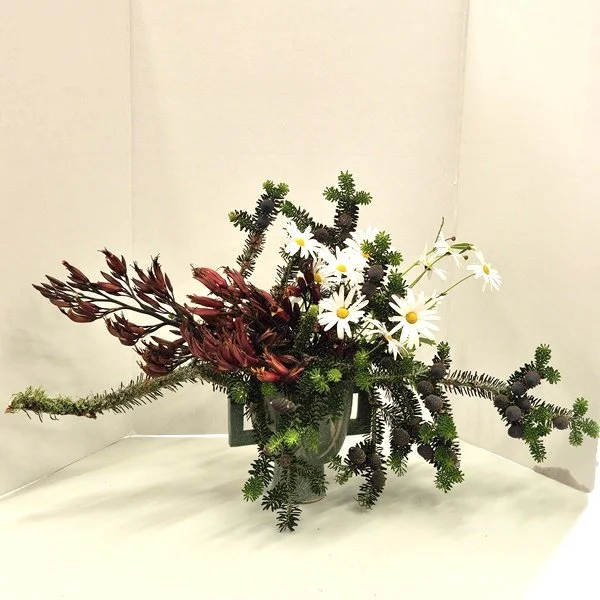
“Theme Book 4, lesson 4, Using Only One Kind of Material.
The material can be only one kind, it can be fresh branches, leaves or flowers in any style. Please choose different materials including, flax, geraniums, hydrangeas, angelica, chrysanthemums, buttercups, alstroemeria, agapanthus. Being mid winter the options are somewhat limited.”
A reminder about registrations for 100 year celebrations in Tokyo, April 2027.
It seems a long time until the big Sogetsu celebrations in April 2027 but registrations for the demonstration and dinner are opening on June 10th. If you are interested in attending please let Helen know as we may be able to book a group of seats and/or a dinner table so we can all sit together. These events are about $500 per ticket. I am happy to book for a group but would need you to pay me before I charge my credit card. Of course you can leave booking an individual seat until later, subject to seats being available but it looks like the group booking needs to be done at the same time.
'What Ikebana Can Do Today' Theme Book 5, lesson 30. A workshop led by Helen Wareham
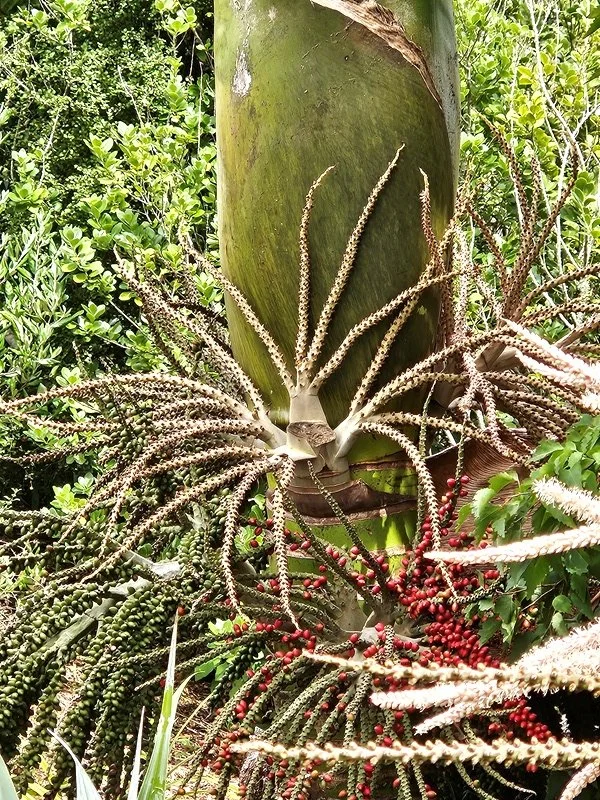
Nikau flowers in Otari
Our May workshop will be held in Khandallah Presbyterian Church Hall venue at 2pm to 4pm on Sunday May 10.
Helen provided the following notes:
In this theme, think about what roles ikebana can play in your future. It may be that you do an ikebana arrangement to display in a new place or lead a workshop for people who wish to learn about ikebana. Make an arrangement which shows your thoughts on ikebana, maybe for a special occasion or highlighting a special material or container.
I will talk about various opportunities we have to display our ikebana and also my experience with workshops for beginners. Our ikebana Wellington group has several items that we can use for ikebana exhibitions and workshops, including publicity materials and tablecloths and our teachers are happy to share their advice. Teaching regular classes does not suit everyone, but you can learn by helping at a beginner workshop.
Workshop led by Takako Oshima. Theme: Composition Expressing a Movement
Flax leaves arranged to show movement
Our workshop will be held in our usual Khandallah Church Hall venue at 2pm to 4pm on Sunday April 12. Takao Oshima will lead the workshop with the theme from Book 5, lesson 18, Composition Expressing a Movement.
Takako has provided the following notes: “For our upcoming workshop, I am using Text 5–18, “Expressing Movement,” as the theme and approaching it in a slightly playful way.
I will prepare slips of paper, each with a single verb written on it (such as “fall,” “play,” “jump,” or “resist”) and place them in a box. Participants will then draw one slip at random, like a lottery, and create a work using the flowers and materials they have, based on the verb they draw.
It may be challenging to express an unexpected theme, but that is also part of the fun and the reward. Of course, if the verb you draw really doesn’t suit your flowers or container, you are welcome to draw again.
To make it feel a bit like a game and to allow for more possibilities, it might be nice if you can bring a few different materials.
This exercise is meant to test our imagination and flexibility in responding to a given theme. By making full use of your skills and creative ideas, I hope it will be a fun and stimulating challenge for everyone”.
A Workshop led by Adriana Nickless with the Theme: Disassembling and Rearranging Materials
Our workshop will be held in our usual Khandallah Church Hall venue at 2pm to 4pm on Sunday March 8. Our Ikebana Wellington AGM will precede Adriana’s workshop and will begin at 12:45pm. The present Committee are happy to continue in their roles.
Adriana has provided the following notes: “My theme combines elements of Disassembling and Rearranging the Materials (Book 4 Lesson 9) and Simplified Arrangement (Book 4 Lesson 8).
In particular finding new and interesting ways to arrange materials while, as Lesson 8 notes achieving “maximum expression possible…by the minimum parts possible”. Also, as we move from Summer into Autumn, those attending the workshop may find it helpful to take some inspiration from the observable effects of seasonal change on available material.”
A Workshop led by Sandi Hurnard. Theme: Glass and Water
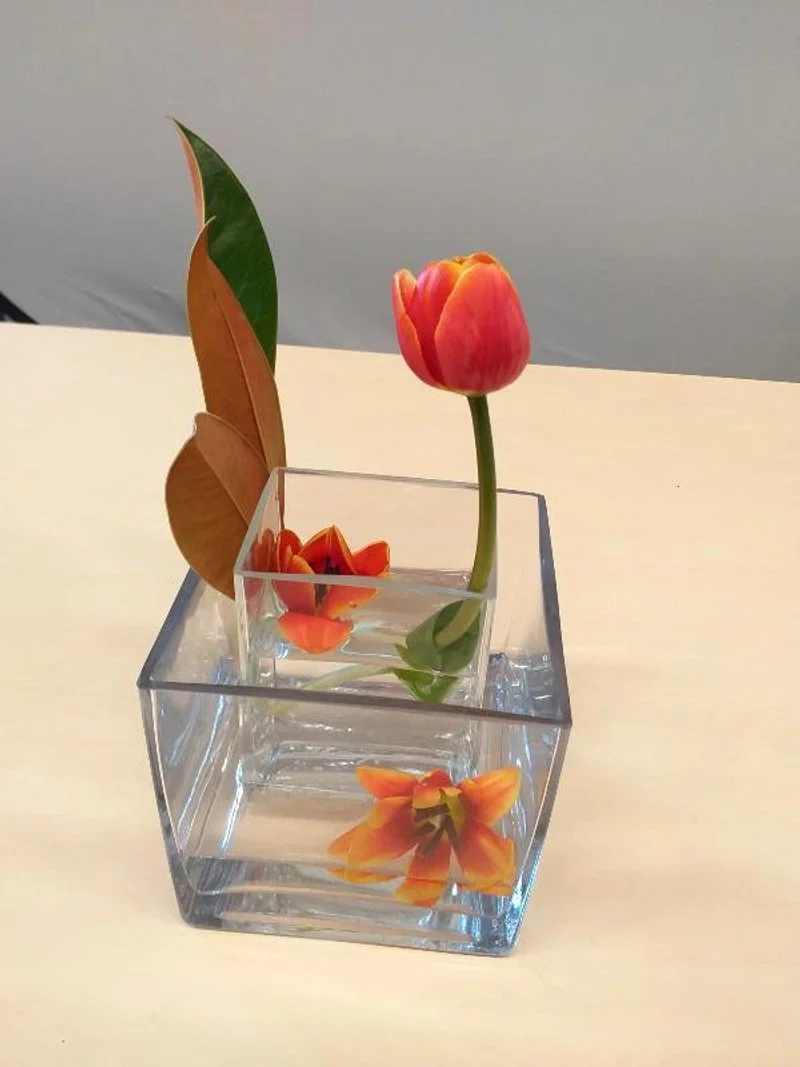
Our February workshop will be held on Sunday 1st February in the hall at Khandallah Presbyterian Church. Sandi will lead the workshop demonstrating using ‘Glass and Water’ with a glass container.
Sandi has provided the following notes:
As February is usually our hottest month, it seems appropriate to revisit the impact of the element of water in our Ikebana.
Glass containers allow us to emphasize the stalks as well as flowers. The positioning of what can be seen in the water should add interest to your composition. Do not use kenzan in your arrangements.
Materials are completely optional but do include greenery.
Beginners should read Book 2 lesson 16 which shows 2 floating examples which will introduce you to floating arrangements. If you don't have a suitable glass moribana your usual one will be fine.
Intermediates Refer to Book 4 lesson 12 page 86-87 with a good writeup you will find helpful.
Advanced Book 5 lesson 13 pages 66-69 have some interesting examples of more advanced compositions.”
Masako will lead a Workshop with the Theme of: Ikebana for Celebrations
Our last meeting for the year will be held at Khandallah Presbyterian Church Hall, 33 Ganges Road, on Sunday December 7 at 2pm until 4pm. Masako will lead the workshop arranging material for celebrations. Masako has provide the following notes:
“Sogetsu textbooks refer to arrangements for festive occasions (Book 1-20 and Book 2-20), specific occasions or spaces (Book 4-19), and celebrations (Boo 5-11).
Please choose one occasion to arrange an ikebana to make someone or group of people feel special.
Rather than following such so-called taboos, be flexible and put the first priority on making the recipients happy.
You can choose any materials or vases for this workshop”
A Workshop Led by Sandi Hurnard and Helen Wareham. The theme is 'Using a second - hand vase'
Our November workshop will be held on Sunday 9 November at 2pm - 4pm in the Khandallah Presbyterian Church Hall, 33 Ganges Road.
For this workshop choose a vase that is pre-loved, maybe something you found at an Op Shop, a family hand-me-down or something you bought from another ikebanist. It may have special significance for you when you consider it’s past.
Sandi and Helen will lead this workshop and hope to have another member also demonstrating. You may choose any style of arrangement for your ikebana, but it should showcase the vase.
Garden to Vase - Picking your own Materials. A Workshop Led by Helen Wareham
Helen arranged grasses, nandina and flowers from her garden
On Sunday 12 October, 2pm - 4pm, a workshop led by Helen will be held in Khandallah Presbyterian Church Hall, 33 Ganges Road.
Helen has provided the following notes:
For this workshop please cut your own materials, branches, leaves and/or flowers and observe how they were growing. It is then easy to make an ikebana arrangement, whether upright, slanting, or horizontal.
Over the years that I have been studying and teaching ikebana I have noticed that students who pick their own materials learn ikebana more quickly and show the materials to best advantage.
The idea for this workshop came to me from Julie Middleton. Julie studied ikebana with me for most of the last 10 years and I can’t remember her ever buying flowers.
She was an expert gardener and used materials from her garden in her ikebana. She also helped others with their garden maintenance and collected flowers and branches from these gardens. I would like you to use materials you pick yourself for this workshop as I have noticed that ikebanists who cut their own materials plan their ikebana ahead and don’t waste the plants.
Julie had special places to pick if she needed a certain material and you may find that you can do the same. If your neighbour has a branch that you want to use, do ask them first and usually people are happy to share.
A Workshop using Bamboo lead by Kate Graham
Our September workshop will be held on Sunday 14th September from 2 to 4pm in the Khandallah Presbyterian Church Hall. Kate will demonstrate how to use bamboo in our arrangements and will bring bamboo for us to use. Kate has provided the following notes about Bamboo:
“It was the Third Iemoto Hiroshi Teshigahara who brought bamboo to the fore in Sogetsu Ikebana. He created large-scale works of undulating and bending bamboo which included straight and curved lines.
The current Iemoto Akane Teshigahara has continued to present large scale bamboo works often incorporating branches and flowering material.
In this workshop we will work on a much smaller scale. We will experiment and play with bamboo to discover ways to use it in our ikebana. I will bring a variety of pieces and sizes of bamboo some cut and some for you to cut or shape yourself.
Please bring some branch and flower material along with some wire. You may like to bring 1-2 containers as your ikebana will be dependent on the bamboo pieces you decide to use.”
Spring Exhibition at the Botanic Gardens Begonia House
The Begonia House at the Botanic Gardens
Enjoy the intricate Japanese flower spring arrangements exhibition – and maybe even pick up a trick or two at one of the teacher demonstrations. The Art of Ikebana exhibition will be in the Lady Norwood Begonia House on Friday 9 September and Saturday 10 September between 9am–4pm, and Sunday 11 September between 9am–3pm.
Teacher demonstrations will be held on Saturday at 11.30am and 1:30pm and Sunday at 1:30pm.
Workshop led by Setsuko: "Through your flower arrangements, your sensibility blooms, and your love for flowers blossoms into confidence.”
An arrangement by Setsuko
Our Ikebana workshop will be held on Sunday August 10, from 2pm to 4pm in the Khandallah Presbyterian Church hall. Setsuko will lead the workshop. It will be an opportunity to practice your arrangement for our September Exhibition at the Begonia House. Setsuko has provided the following notes on her theme:
"Through your flower arrangements, your sensibility blooms, and your love for flowers blossoms into confidence.” “How can we achieve that? Please read through the following quotes as your reference.
Sofu Teshigahara wrote about ‘Good Ikebana’ in one of his Lesson notes (Ikebana Sogetsu No. 256 June 2001).
“Good ikebana has movement within it. Plants don't move, but they should look as if they're moving. In Sogetsu ikebana, a feeling of movement comes from the arrangement. Green colour gives the impression of movement because when we look at a plant, we react instantly to its green mass.
‘Beauty’ is an abstract word that refers primarily to colour but also to shape. Beautiful shape is a product of lines and mass. Remember that lines move but mass doesn't when you decide where to give emphasis to movement and mass. It is important to remember that ikebana is not just about lines and mass. The originality and sophistication of the artist are also important.
Of the utmost importance, however, are the three major ikebana techniques: ’cut’, ‘fix’ and ‘bend’.
Cut until you get blisters. Let your fingers bond with the scissors
Bend branches and other vegetation to a form you like
Fix the flowers and branches without using a kenzan (needle point).
Practice these three techniques until you come to be known as an expert.”
Setsuko emphasising line
Akane Teshigahara wrote that “Flowers embody the essence of the heart” (Sogetsu quarterly Summer 2025 No. 365). "How are we to express that formless and invisible essence of the heart?”
I think about this constantly and try to put it into practice through a process of trial and error. Above all, I try to be true to myself and to the flowers. I believe it is essential to open our hearts and minds to the changing shifts and currents of society. “My ikebana” must give rise to emotions that extend far beyond accumulated knowledge and established practice through such an attitude. The past Iemotos (headmasters) have conveyed this thought in their various words and expressions, and I believe they themselves practiced throughout years."
I encourage you all to practice the above techniques at the monthly workshops and prepare yourselves for the Wellington Botanical Garden Exhibition.
Kind regards,
Setsuko
Winter Season Arrangement using Bare Branches lead by Sandi Hurnard
Lichen-covered branch with camellia flowers and foliage in a tall ceramic vase
Our Ikebana Wellington Workshop will be held on Sunday 13th July in the Hall at Khandallah Presbyterian Church at 2pm - 4pm.
Sandi has provided the following notes and photos.
“Winter is a great time to explore different branch materials when leaves have dropped. By emphasising branch or vine lines the creation of beautiful arrangements are still possible - especially if the branches are lichen covered and unusual green-grey or even orange colours are more prominent.
I would like you to create an arrangement that contains at least one bare branch or vine. You can still make use of NZ native evergreen plant material or add conifers or flaxes.
Flowers can be kept to a minimum though some of you may be lucky enough to have camellia in your gardens or even berry material. You may like to bring a second small container to light up a more intimate corner.”
Sogetsu Workshops with Takako Martin
Takako demonstrating tulips and flax in a white triangular container
Sogetsu Teachers Association Wellington are pleased to be hosting Auckland based Sogetsu teacher Takako Martin (Riji Teacher) for three workshops on Saturday 7th June and Sunday 8th June 2025. Takako has visited Wellington many times and her workshops are always a great experience for students as well as teachers. We will welcome Takako at a casual dinner on Friday 6th June at Helen’s place. No charge but BYO drinks.
The three workshops will be held at the Khandallah Presbyterian Church Hall, Ganges Road, Khandallah at:
Saturday June 7, 11am to 1pm,
Colours in the Same tonal Range - Book 3, lesson8
2pm to 4pm, Colours in Contrast - Book 3, lesson 9
Sunday June 8, 2pm to 4pm, Two or More Containers - Book 3, lesson 4.
See Registration Form in recent email from Helen.
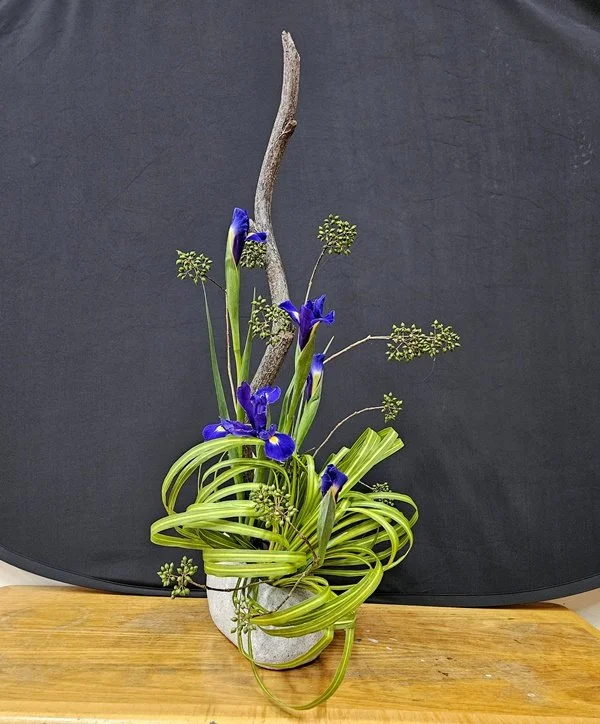
Kathy Kerry leads a workshop using Leaves Only
Our Ikebana Wellington workshop will be held on Sunday May 11 at 2pm in Khandallah Presbyterian Church Hall. Kathy will demonstrate from Book 4 lesson 2, ‘With Leaves Only’.
Kathy suggests: ‘Leaves Only’ arrangement focuses on using a variety of leaves to create a unique and visually interesting composition, encouraging creativity and freedom of expression, allowing for manipulation of leaves like folding, rolling, or tearing to highlight their different textures, shapes, and colours. This lesson encourages exploration of the hidden beauty of leaves by presenting different sides and exploring the plant material.
AGM followed by a Workshop by Adriana on arranging Miniatures Ikebana
Lynn’s miniature ikebana arrangements displayed in front of a wooden tray
Our workshop on Sunday 13th April at Khandallah Presbyterian Church, 33 Ganges Road, will include the AGM of our Sogetsu Branch at 1:30 - 2:15pm. We do not need to have a full election this year, except for the position of Secretary as Sandi Hurnard has resigned from the Committee. If you would like to join the committee as Secretary, get in touch and Helen will tell you more about the position.
Straight after the AGM, Adriana will lead a workshop on the Book 5 lesson, Miniatures Ikebana. Miniatures have been part of Sogetsu studies for many years and were a speciality of the second Headmaster, Kasumi Teshigahara. The Book 5 lesson suggests that we use several of our smallest containers and group them on a base plate, tray or paper.
A Workshop lead by Els Schnabel demonstrating the use of various Fixtures in Ikebana Arrangements
On Sunday March 9, 2pm we will meet in the Khandallah Presbyterian Church, 33 Ganges Road for a workshop lead by Els Schnabel. She will demonstrate various methods of fixing material in a variety of containers.
A Workshop lead by Elizabeth McMillan on Highlighting Gladioli
Stones highlighting leaves, highlighting delicate flowers
We will meet on Sunday February 9, at 2pm till 4pm in the Khandallah Presbyterian Church, 33 Ganges Road.
Our first workshop of 2025 will focus on using gladioli in our ikebana. There are plenty of gladioli in the shops at present or you may have some in your garden. Think of ways to showcase these majestic flowers and celebrate summer. Your choice as to moribana or nageire.
Takako Oshima will lead a workshop on Celebration Flowers'
Sandi used pohutukawa flowers and foliage and enhanced with gold Mizuhiki cord
Our last workshop for the year will be held at 2pm till 4pm in the Khandallah Presbyterian Church Hall on Sunday, December 1st. The workshop will be taken by Takako Oshima on Celebration Flowers. There are several textbook arrangements for celebrations as often we arrange ikebana when guests are coming. A Christmas or New Year arrangement is appropriate for this time of year, or maybe a wedding celebration or Christening this summer.
Takako has provided the following special notes about Ikebana for New Year:
In Japan, New Year's arrangement is the most popular arrangements for celebrations. New Year’s arrangements typically include auspicious items such as pine, sacred berries like senryou (Christmas berry), and nanten (nandina), along with kiku (chrysanthemums), which are believed to have medicinal properties promoting longevity. As you select the materials and vase for your arrangement, I hope you will consider what occasion or celebration the flowers will represent, reflecting on the meaning and significance behind the choice.
Book 5 tells us “Make an arrangement to express the wholehearted feeling of celebration”. And “Never forget that arrangements for celebrations are made primarily for showing your congratulatory feelings to the recipients”
Book 5, lesson 11 Arrangements for Celebrations
Book 4, lesson 19 Specific Scenes, Occasions or Spaces
Book 1, lesson 20 and Book 2, lesson 20 Special Materials and Arrangements for Festive Occasions
Helen Wareham will lead a workshop demonstrating, One arrangement using Two or more Containers
An example of using two different containers
Our next workshop will be held on Sunday 10th November in the Hall at Khandallah Presbyterian Church. The hall will be open from 1:30 and our workshop will be from 2 to 4pm.
There are several textbook arrangements using 2 or more containers: Book 2, lessons 17, 18 and 19 and Book 3, lesson 4.
We usually look for containers that match in shape or size for this, but challenge yourself to use containers of different shapes and sizes, or perhaps to use one of the containers as a sculptural element rather than a vase for flowers. The material in each container can be used to co-ordinate or contrast the containers.
A Workshop to prepare arrangements for the Japan Festival
On Sunday September 8 in the Khandallah Presbyterian Church hall at 2pm - 4pm, a workshop will be held to practise arrangements for the display at the Japan Festival. Members will organise a roster for helpers on Saturday September 16.
The Art of Ikebana Exhibition at the Botanical Gardens, Begonia House
The Spring Festival Ikebana Exhibition will be held in the Lady Norwood Begonia House at the Wellington Botanical Gardens on Saturday 31 August and Sunday 1 September.
The exhibition will be open from 9am till 4pm on each day. Free admission.
Setsuko will lead a workshop on the 49th Sogetsu Principle, Emphasising Lines
Setsuko’s arrangement in a tall bamboo container shows arum lilies and magnolia leaves
On Sunday August 11, our workshop will be held from 2pm to 4pm in Khandallah Presbyterian Church hall, 33 Ganges Rd, our new venue. It will be lead by Setsuko Kennedy.
Setsuko has provided the following notes:
”I want to lead the 11/August workshop with the 49th principle of the 50 principles of Sogetsu: “the four principles of ikebana are a fresh approach, movement, balance, and harmony; the three elements are line, colour and mass. In Sogetsu Ikebana, the line is particularly important among these three elements. So, after considering the four principles mentioned above of Ikebana, please refer to the lessons of Book3 - lessons 5, 6, and 7, and you can choose one of those three lessons:
Book 3-5: composition of straight lines,
Book 3-6: composition of curved lines,
Or Book 3-7: composition of straight and curved lines.
I look forward to enjoying ikebana with you on Sunday.”
A reminder:
Spring Festival Ikebana Wellington Exhibition
Wellington Botanic Gardens, Begonia House
Saturday 31st August - Sunday 1st September
10am to 4pm
Free admission
Adriana will lead a workshop arranging Dried, Bleached or Coloured Materials
Our July meeting will be held on Sunday 14th at 2-4pm in the Khandallah Presbyterian Church Hall, 33 Ganges Road.
Adriana Nickless will lead this workshop and has provided the following notes:
Book 4 lesson 13 - Dried, Bleached, or Coloured Materials. For this lesson, you can use dried, bleached or coloured materials alone or combined with fresh plant material. The important thing to note is the dried, bleached, or coloured material must be plants. For example, you can use materials such as dried and painted leaves, bark, driftwood, seed pods, dried seaweed or mosses. However, the materials should not be heavily processed (e.g. painted bamboo skewers, cork, paper), which you would instead use in an unconventional material arrangement (refer lessons 4.11 and 5.7).
The plan for the workshop is for everyone to bring a selection of dried, bleached, or coloured materials that can be shared. You may recall the same approach for the unconventional materials workshop last year. While challenging, this encourages more spontaneous arrangements using materials you may not have tried before.
The teacher’s class at Elizabeth’s have been working with dried materials recently and the photos in the gallery are from that class.
Masako will lead a workshop on how to arrange flowers and branches in a suiban without a kenzan
Our June workshop will be held in the Khandallah Town Hall on Sunday 9 June from 2pm - 4pm. Masako will demonstrate how to arrange flowers and branches in a suiban container without kenzan, Book 4, lesson 18 and Book 5, lesson 8.
Masako suggests:
Devise a way to support your flowers and branches without kenzan. Fixing tools to make the main structure steady can be anything for heavy branches and delicate flowers. Bending techniques are useful, too. Without kenzan you can show the beauty of the vase and water feature.
“Explore a new creative style of composition in which the plant materials are rising vigorously from the container.”
If you have other ways to support materials in a container rather than suiban, you are welcome to show to the group. However, this does not include nageire styles.
A Workshop with Elizabeth about using Leaves Only
Autumn leaves in the Botanical Gardens
The next workshop will be on Sunday 12th May 2 to 4pm at our usual meeting place, Khandallah Town Hall.
Elizabeth McMillan will lead this workshop on the lesson “Leaves only” Book 4, lesson 2.
To quote from the textbook:
“Make an arrangement only with leaves of two or more kinds,… Leaves can show different characteristics by rolling up, tearing or overlapping them. The same leaves can give an entirely different impression by presenting their reverse side…Try to discover new characteristics of the leaves”.
Elizabeth suggests we may like to use autumn leaves if available.
Sogetsu Wellington AGM and a shared Workshop celebrating Autumn
Autumn time
Our Sogetsu Wellington AGM and Workshop will be held on Sunday 14th April 2-4pm at Khandallah Town Hall.
This year is an election year for our club's committee. After two years in the role Kate has decided to step down as Chairperson; as has Setsuko as the Deputy Chairperson. They have both enjoyed their time over this period and look forward to contributing to and supporting the club.
This will allow for some new members to take over the roles as it is always valuable to share in the running and knowledge of the club. As we are a Branch our Chairperson must be a teacher and member of STA Japan and the deputy must also be a member of STA Japan.
Please see Kate’s latest email for the AGM and nomination form.
A Workshop with Helen demonstrating arrangements using a variety of materials
Our March workshop will be held in the Khandallah Town Hall at 2pm till 4pm. Helen Wareham will demonstrated how to create an arrangement using a variety of materials.
Book 4, lesson 5 - A Variety of Materials. Prepare an ikebana arrangement using at least 5 materials. The textbook suggests mainly flowers but Helen suggests using grasses, maybe from the roadside, to celebrate the end of summer.
When I first studied this arrangement it was called ‘Maze-zashi’, the Seven Grasses of Autumn’. A basket or a rustic container would be suitable.
A workshop on creating an arrangement using agapanthus only, lead by Kathy Kerry
Kathy enjoying time with agapanthus flower heads
Our first workshop for 2024 was held as usual in the Khandallah Town Hall at 2 - 4pm. Kathy Kerry demonstrated how to create an arrangement using only agapanthus.
Useful information can be found in:
Book 4, lesson 4 - One kind of material
Book 4, lesson 9 - Disassembling and rearranging the materials
Book 4, lesson 12 - Focusing on the uses of water.
We said farewell to Misako Ito who is leaving New Zealand to begin a new posting with her husband in Greece. Misako will be missed.
Setsuko Kennedy will lead a workshop showing Ikebana Arrangements for Celebrations
This is the "Special Occasion arrangement" Satomi Takahashi did for the Emperor's Birthday reception at the Public Trust hall in March this year. The event was attended by 300 guests and officials.
Our December 3rd workshop will be held in the Khandallah Town Hall from 2 until 4pm. Setsuko will demonstrate arrangements for celebrations from Book 5, lesson 11, and Book 4, lesson 19.
The theme for the workshop is Celebrations. "The idea is to show that the arranger joins in the celebration mood by means of ikebana."
‘Celebration’ includes any seasonal festivals, Christmas, Easter etc. Consider the colours of your material and the shape of your arrangement. A spreading wide open fan shaped arrangement is supposed to symbolise a prosperous future and increasing good luck.
Pine branches represent longevity, good fortune and steadfastness. Pine is commonly linked with virtue and long life.
The use of Mizuhiki (paper strings) is effective for arrangements as they add to the special atmosphere.
"Whenever you get a chance, make an arrangement from your heart for those celebrating the occasion."